Written by Very N'Ice technical team · Updated October 2026
Definition
An ice skating trail (also called an ice trail or ice path) is a real ice surface shaped as a route. Instead of skating in circles inside a fenced rectangle, visitors travel along a curving path that can pass between trees, follow a street or wrap around a rink.
Technically it works just like a rink: a cooling floor carrying coolant chilled by a chiller, on which the ice forms. The difference is the shape, and that shape means every trail has to be custom-designed.
Ice trail formats
| Format | What it is | When it fits |
|---|---|---|
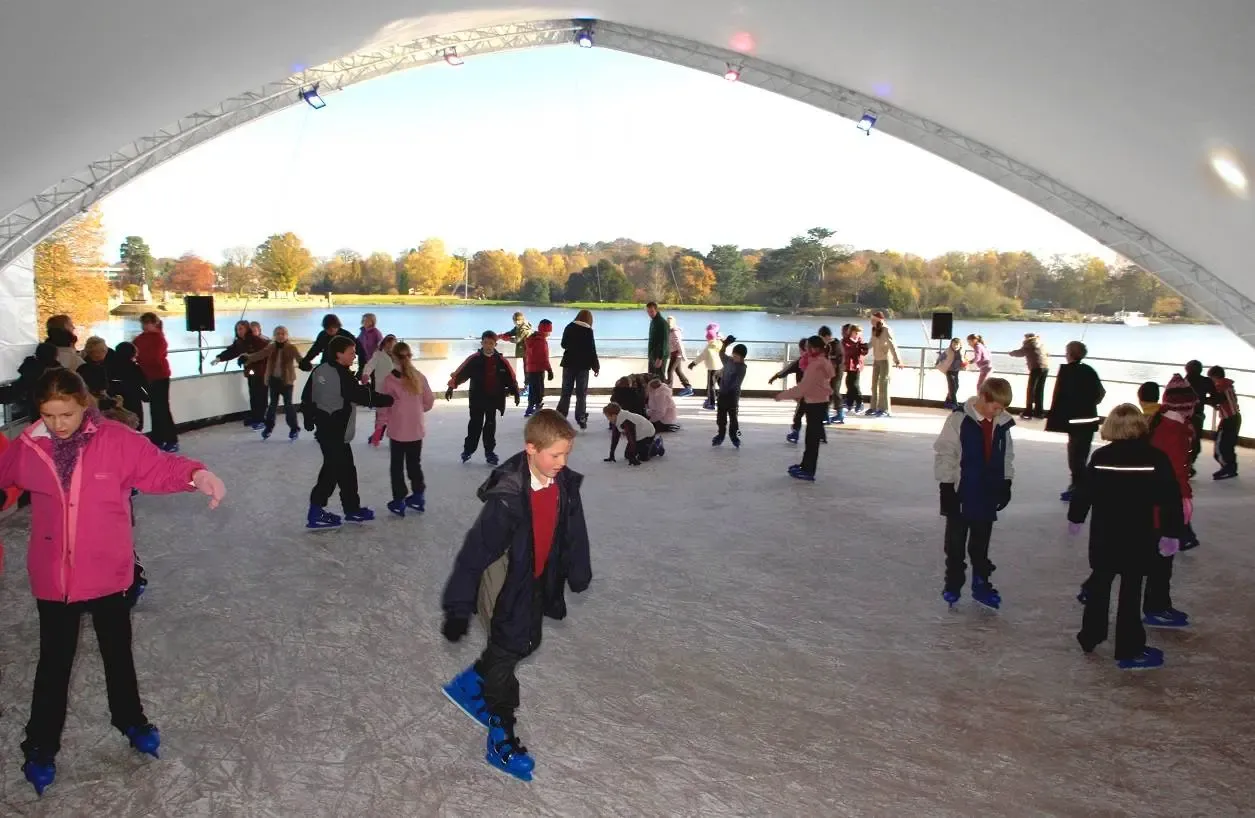
| Perimeter trail | A corridor running around an ice rink | Extending an existing rink or offering two experiences on one site |
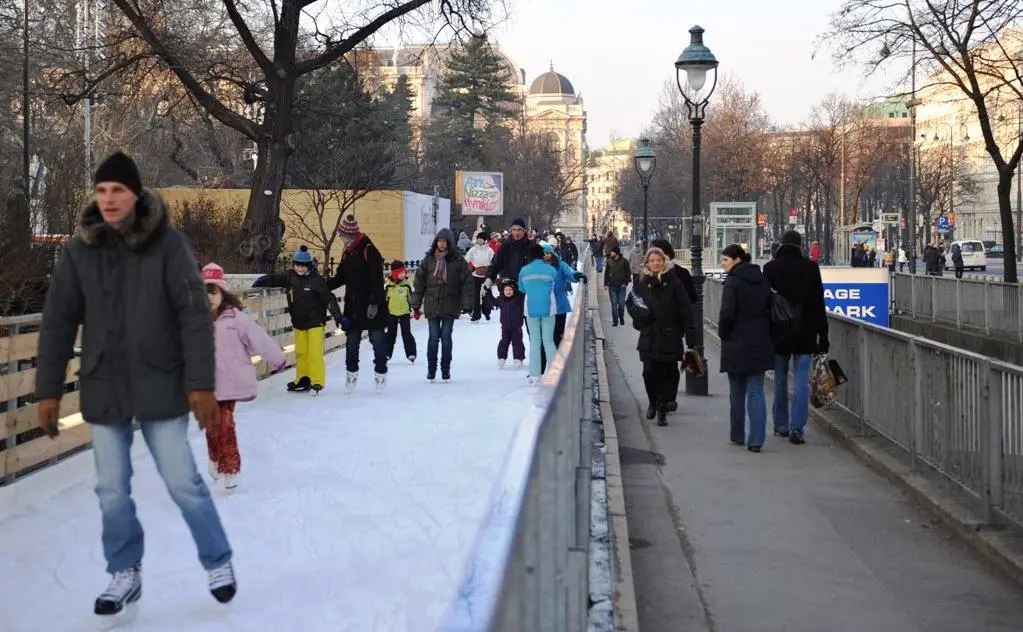
| Ice street | A street or promenade turned into a skating path | Historic town centres and pedestrian promenades, with or without a rink at the end |
| Park trail | A route through green space | Urban parks, gardens, theme parks |
| Closed circuit | A loop in whatever shape the space allows | Exhibition grounds, shopping centres with long, narrow spaces |
| Trail leading to a rink | A path that connects to a central rink | Large Christmas events |
We have no shape or size limits: we start from the client’s idea and our engineers and technicians work out how to make it viable.
Dimensions
There are no standard dimensions. Each trail is designed around the space, the expected visitors and the budget. As a reference:
- Width: set for each project. It can be made wider if large crowds are expected or comfortable overtaking is wanted.
- Length: depends on the space available. The Guadalajara trail was 600 m long.
- Capacity: as a first approximation, use the same rule as for a rink, about 3 m² per skater. On a trail the direction of travel and the entry and exit points also matter, so we fine-tune this in the project.
Case study: 600 metres in Guadalajara (Mexico), 2019
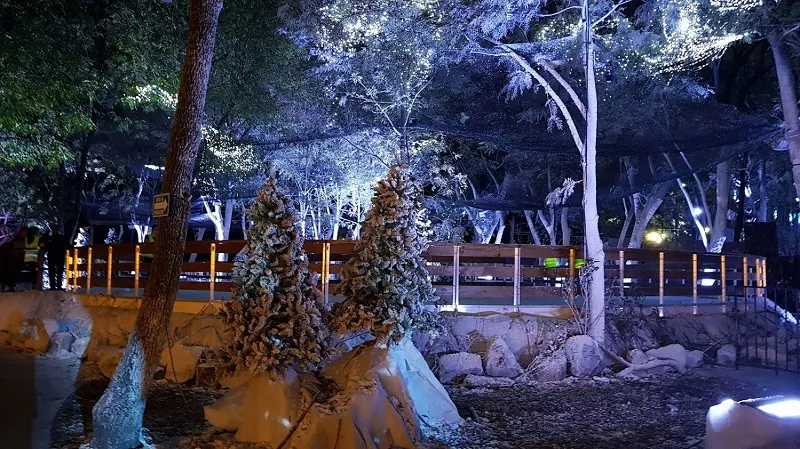
In December 2019 we installed a 600-metre ice trail at Navidalia, Guadalajara, for the Christmas season. The route crossed a park, so visitors skated along a path rather than round a rectangular rink.
The project shows two things. First, an ice trail can be considerably long if the cooling system is sized to keep the ice even along the whole route. Second, it works in a city with a mild climate, not only in cold winters (see ice rinks in warm climates).
Ice trail vs ice rink: the differences
| Aspect | Ice trail | Ice rink |
|---|---|---|
| Shape | Long, narrow, curving route | Rectangle, usually in a 2:1 ratio |
| Experience | Skating forward, like a stroll | Skating in circles |
| Space it uses | Streets, promenades, parks, perimeters | Squares and rectangular areas |
| Design | Always custom | Standard modular sizes, from 200 to 800 m² or more |
| Hockey, lessons, shows | No | Yes, on large enough rinks |
Per square metre, a trail costs more than a rink: there is more barrier perimeter per metre of ice and the design is always bespoke. In return, it turns a space that cannot take a rectangular rink into an attraction and offers an experience people remember.
What to consider before ordering an ice trail
- The layout: very tight bends or changes in level complicate the project. A site plan with dimensions lets us propose a route.
- The ground: as with a rink, it has to be level along the whole trail.
- The plant: it needs outdoor space close to the route. On long trails we study where to place it so pipes are short and well insulated.
- Sun and cover: a long trail is hard to cover completely. Outdoors, shade and the season’s temperature matter a great deal (we recommend under 24 °C in the open air).
- Entrances and exits: plan where skates are put on, how people get onto the ice and the direction of travel.
- Electricity and water: a three-phase supply with earth and a drinking water connection, as for any rink (see technical requirements).
Combining it with other attractions
An ice trail works very well alongside a rink: visitors enter via the trail and finish on the rink, or the other way round. It can also be paired with an ice slide or a Neveros® snow play area to create a complete Christmas venue. If they are booked together, we apply a discount.
More photos and details on our ice skating trails page and in our custom-shape ice rinks. If you have a space in mind, send us a plan or some photos and we will propose a route with a price. Request a quote.