Written by Very N'Ice technical team · Updated October 2026
How much electricity an ice rink uses: benchmark figures
There is no single consumption figure, but there are published ranges:
| Source | Consumption | Context |
|---|---|---|
| Rogstam, 2010, via IIR | Average 2.2 kWh per m² per day; range 1.5 to 4 | Indoor ice arenas in Sweden, total building consumption |
| Xtraice (synthetic ice manufacturer) | Around 3 kWh per m² per day | Average it publishes for real ice rinks |
| Very N’Ice calculator | 3 kWh per m² per day | Cautious assumption for temporary rinks |
The Swedish study measures permanent indoor arenas, where refrigeration accounts for 35 to 75% of total consumption. A temporary outdoor rink is more exposed to sun and wind, which is why we use 3 kWh rather than 2.2.
Electricity cost by rink size
At 3 kWh per m² per day over a 6-week season (42 days):
| Rink | kWh per day | kWh over 6 weeks | Cost at €0.18/kWh | Cost at €0.25/kWh |
|---|---|---|---|---|
| 10 x 10 m (100 m²) | 300 | 12,600 | €2,268 | €3,150 |
| 10 x 20 m (200 m²) | 600 | 25,200 | €4,536 | €6,300 |
| 15 x 30 m (450 m²) | 1,350 | 56,700 | €10,206 | €14,175 |
| 20 x 30 m (600 m²) | 1,800 | 75,600 | €13,608 | €18,900 |
| 20 x 40 m (800 m²) | 2,400 | 100,800 | €18,144 | €25,200 |
These are indicative calculations. Actual consumption may be lower for a covered rink in winter or higher for a rink in hot sun.
A measured reference from a Very N’Ice rink
A 300 m² Very N’Ice rink draws 80 to 100 amps on a 380-volt three-phase supply. That is equivalent to about 53 to 66 kVA of apparent power (√3 × 380 V × 80 to 100 A).
Another real measurement: a 15 x 25 m (375 m²) rink at an ambient temperature of 28 °C drew 83, 91 and 82 amps on its three phases. The 91 A phase also powered the rink’s lights and sound.
This is the demand with the chiller at full load, not the daily average. The chiller starts and stops by itself as the ice requires, and in winter it can sit idle for hours. So daily consumption is well below that power multiplied by 24 hours. The figure is mainly useful for sizing the electrical supply, which we calculate for every project (see technical requirements).
What pushes consumption up
| Factor | Effect |
|---|---|
| Direct sun | The biggest heat load outdoors |
| Air temperature and humidity | More heat and condensation to remove |
| Wind | Increases heat exchange over the ice |
| Uncovered rink | Exposed to sun, wind and rain |
| Uninsulated ground under the rink | Cold is lost freezing the ground |
| Manifolds outside the rink | They freeze the air instead of the ice |
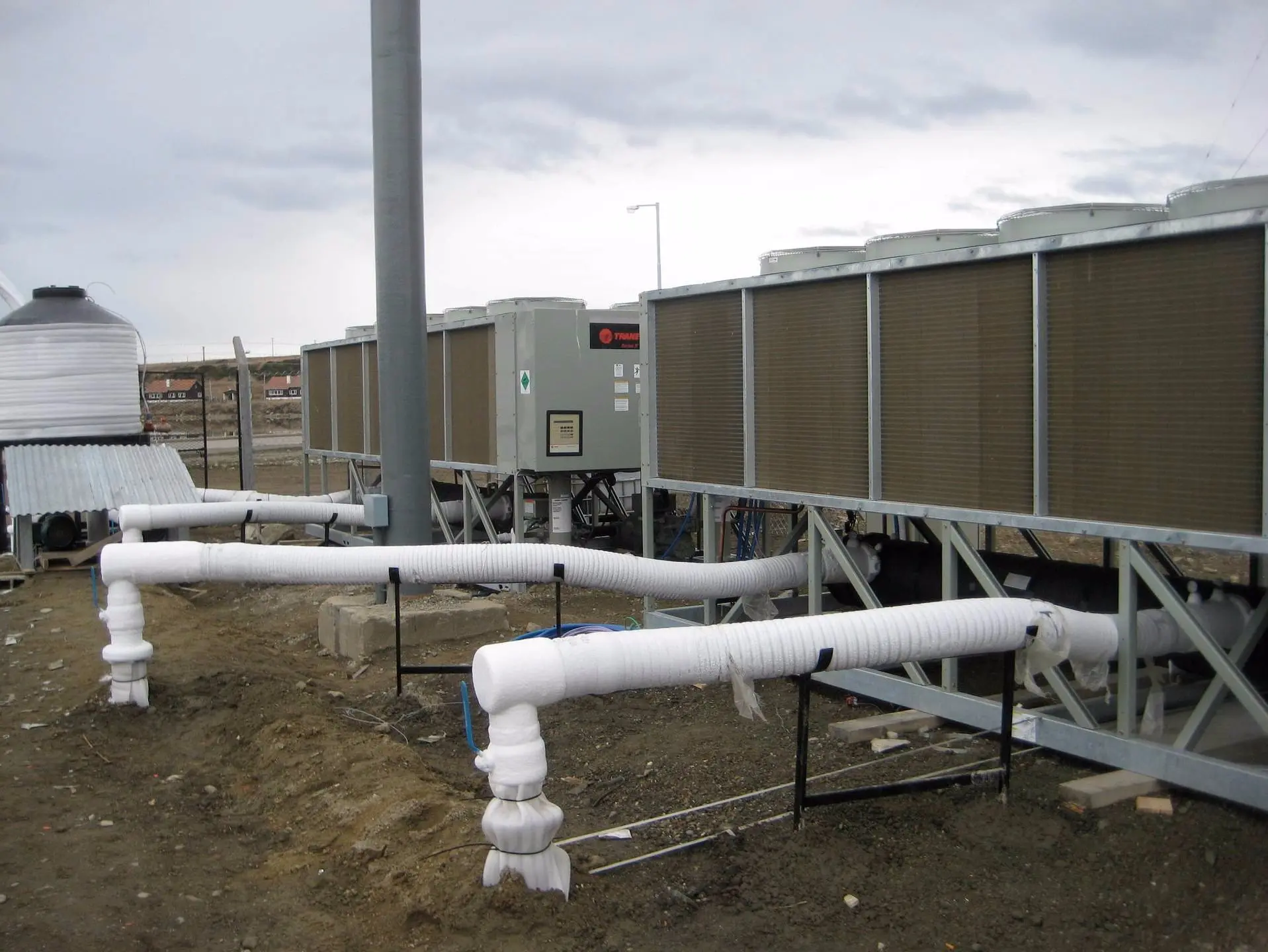
| Uninsulated pipes | They ice up and lose cold along the way |
| Plant far from the rink | Longer pipes, greater losses |
| Ice too thick | More mass to cool |
Why the Very N’Ice system uses less
At Very N’Ice we treat the rink and the plant as a single machine: the energy that goes in should come out as cold on the ice, with minimal losses. Our freezing system was designed for that:
- Insulating board under the cooling floor: the cold goes upwards, where the ice forms, not into the ground.
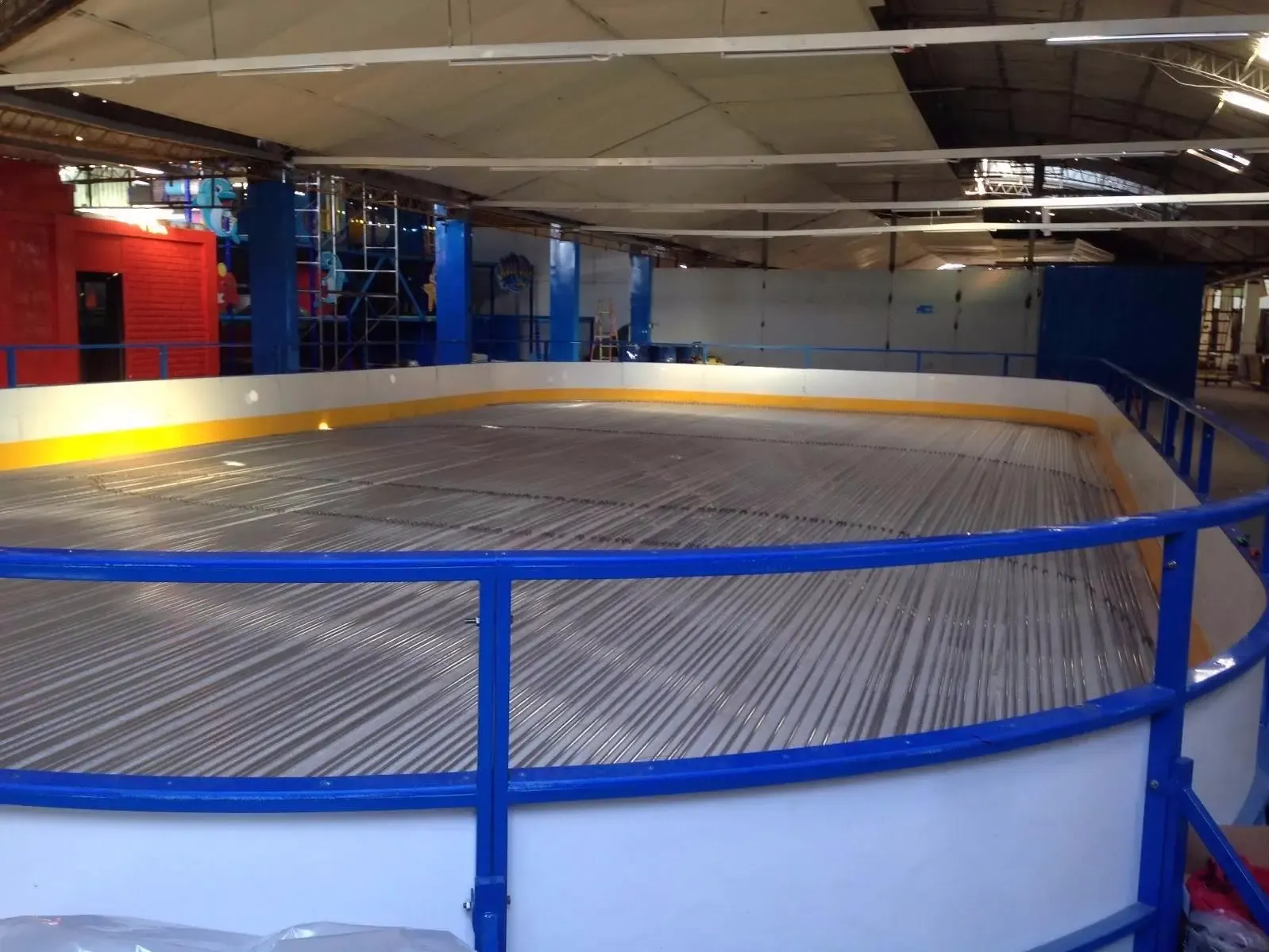
- Manifolds inside the ice: the pipes that distribute the coolant also produce cold. Only two insulated pipes leave the rink.
- Tempered aluminium pipework with 2 mm walls: aluminium conducts heat very well and does not leak.
- Double insulation and propylene glycol as the coolant.
You can see the result on the chiller display: less than 1 °C difference between flow and return temperature. In our observation, traditional systems lose 3 to 5 °C. With this design, Very N’Ice states electricity consumption at least 40% lower than traditional systems, and guarantees it in writing in the contract.
Applied to the table above, a 40% saving on €10,206 for a 450 m² rink would be around €4,000 over a 6-week season. This is an estimate based on our consumption assumption, not a measurement.
How to reduce your rink’s consumption
- Cover it. A marquee that shades the whole ice surface is the single biggest saving outdoors.
- Place the plant close to the rink. If that is not possible, use pipes with reinforced insulation.
- Insist on insulation under the cooling floor and manifolds inside the rink. When comparing bids, ask about both.
- Keep the ice thin. Clearing snow and flooding with a very thin layer stops the ice building up and the plant cooling extra mass.
- Do not switch the plant off at night. The chiller already regulates itself; switching it off means recovering the ice afterwards.
- Service the plant every 6 months (oil and refrigerant levels) so it runs at full efficiency.
- Negotiate your electricity tariff before the season: the price per kWh matters as much as consumption.
If electrical power is the constraint
We only work with real ice, so the rink always needs cooling. If the available power is tight or the kWh is very expensive, what helps most is adjusting the ice area, covering the rink and looking after the insulation. We review this with you before sizing the chiller and the electrical supply (see technical requirements).
To find out what your specific rink would use, tell us the location, size, dates and whether it will be covered. Request a quote or try your figures first in the profitability calculator.